
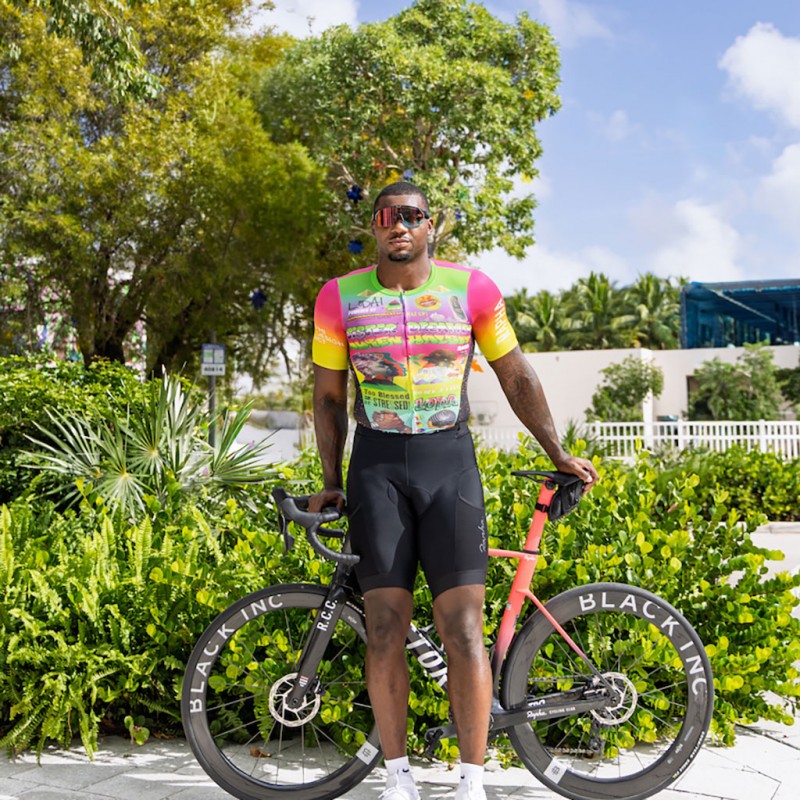

Miami Design District and Lauren Halsey Turn a Cycling Jersey Into a Work of Civic Art
Jesse JamesA Garment That Carries More Than a Logo
When a piece of performance apparel is designed well, it disappears into the body. It becomes something worn rather than noticed, something functional rather than expressive. The limited-edition Pro Team Training Jersey created by Lauren Halsey in partnership with the Miami Design District and Rapha moves in the opposite direction. It does not seek invisibility. It seeks presence. It treats the jersey not only as a technical object, but as a carrier of meaning, memory, and responsibility.
This project emerged as part of the Miami Design District’s official cycling team’s participation in the Dolphins Cancer Challenge, a movement that has, since 2010, raised nearly one hundred million dollars for cancer research at the Sylvester Comprehensive Cancer Center. In that context, the jersey is not simply merchandise. It is a symbol of collective action, a visual language for solidarity, and a tangible way to connect art, sport, and public good.
That connection gives the garment its emotional gravity. It exists within a chain of relationships: between riders and patients, between artists and communities, between institutions and causes. Each thread of fabric becomes a thread of participation.
Lauren Halsey’s Visual Language in Motion
Lauren Halsey’s work has always been concerned with how visual culture shapes community identity. Her sculptures, installations, and architectural interventions draw from the signage, typography, geometry, and vernacular of South Central Los Angeles, translating everyday visual codes into monuments of recognition and care.
Her design for the cycling jersey carries that same logic into a new medium. The vibrant forms, bold geometry, and rhythmic patterning evoke the visual environment of her neighborhood, but here they are translated into motion. What is static in sculpture becomes dynamic on the road. The jersey moves through space, through crowds, through cities, carrying Halsey’s language beyond the gallery and into lived experience.
This translation matters. It allows art to operate not as observation but as participation. The jersey is not a representation of community. It becomes part of one.
Cycling as Collective Ritual
The Dolphins Cancer Challenge is not simply a sporting event. It is a ritual of remembrance, hope, and collective effort. Tens of thousands of participants ride not to compete, but to contribute. They move not toward a finish line, but toward a shared purpose.
Within that ritual, the jersey becomes a uniform not of hierarchy, but of belonging. It marks the rider as part of something larger than themselves. Halsey’s design amplifies that feeling by making the garment visually articulate. It does not reduce the rider to a number. It gives them a voice.
This is where performance wear becomes cultural wear. It functions not only to support the body, but to communicate values.
The Miami Design District as Cultural Mediator
The Miami Design District has positioned itself over the years not merely as a retail destination, but as a cultural platform. Its collaborations often sit at the intersection of art, design, and public engagement. By inviting Halsey into this project, the District extends that ethos into the realm of sport and philanthropy.
This gesture reflects a belief that culture does not belong in isolated spaces. It belongs where people live, move, and gather. The cycling jersey becomes a mobile exhibition, a distributed artwork that exists simultaneously in hundreds of places.
The fact that the jersey is worn during the Challenge and also made available for purchase in-store and online extends its reach beyond the event itself. It allows individuals to participate whether or not they ride, creating multiple points of entry into the project.
Art as Infrastructure for Care
Craig Robins’s observation that Halsey’s work challenges the boundaries between art, architecture, and activism is particularly relevant here. The jersey sits at the intersection of those domains. It is designed, it is worn, and it acts.
This functional activism distinguishes the project from symbolic gestures that remain abstract. The proceeds from the jersey directly support cancer research. The art does not merely comment on care. It contributes to it.
This alignment between form and function gives the project ethical coherence. The aesthetic is not detached from the purpose. It is integrated into it.
A History of Creative Participation
Halsey joins a lineage of artists who have contributed to the Miami Design District x Dolphins Cancer Challenge collaboration, including Mario Ayala, Bisa Butler, Daniel Arsham, Urs Fischer, and Harmony Korine. Each has brought a distinct voice to the project, turning the annual jersey into an evolving archive of contemporary creativity.
This continuity transforms the jersey into a cultural document. Over time, it becomes a record of how art responds to collective need, how artists engage with public life, and how design can operate as social language.
Halsey’s contribution fits naturally within this lineage while introducing a new sensibility rooted in community recognition and visual affirmation.
Movement as Meaning
What distinguishes this project from many art collaborations is its relationship to movement. The jersey is not meant to be still. It is meant to travel. It moves through neighborhoods, across bridges, into stadiums, and through crowds.
This movement carries meaning with it. It distributes attention. It invites conversation. It allows art to circulate rather than concentrate.
In this sense, the jersey becomes a form of mobile architecture, a structure built not of steel or concrete, but of fabric, bodies, and intention.
Early 2026 as a Cultural Moment
The jersey’s debut in January 2026, followed by its presence at events such as “Ride With The Champs” and the main Dolphins Cancer Challenge at Hard Rock Stadium on February 28, positions it within a specific temporal rhythm. It enters the year as an opening gesture, a reminder that action, not abstraction, defines progress.
It asks participants to begin the year not with consumption, but with contribution.
A Design That Refuses Neutrality
The jersey does not attempt to be neutral. It is bold, vibrant, and unmistakable. This refusal of neutrality is itself political. It insists that care should be visible, that community should be recognized, and that art should take responsibility for its presence in the world.
In that sense, the jersey is not only a design. It is a declaration.
It declares that art belongs in the street as much as in the museum. That performance wear can carry purpose. That community impact is not an afterthought, but a central goal.
A Garment That Holds a Promise
Ultimately, the Miami Design District x Lauren Halsey x Rapha Pro Team Training Jersey is a promise stitched into fabric. A promise that creativity can serve care. That design can serve community. That movement can serve meaning.
It asks the wearer not only to ride, but to remember why they ride.
And in doing so, it turns a simple garment into a shared act of hope.
DOWNLOAD PDF ORIGINAL SOURCE